Basic Policy and System
- Basic Approach to Corporate Governance
- Corporate Governance Institutions
- Management Monitoring System
- Internal Control System
- Risk Management System
Basic Approach to Corporate Governance
The Management Principle of the Company is "Contributing to International Society and Continuously Increasing Our Contribution" through the Company's small motors business. The Company understands that realizing this principle is its raison d'être. Corporate governance of the Company comprises the organizational structure and managerial systems that support the realization of its Management Principle and various management measures that maintain these systems. Accordingly, the fundamental objective in establishing and implementing an appropriate corporate governance framework is to further the interests of shareholders and other stakeholders on an ongoing basis through the creation of fair profits and the enhancement of corporate value. Constructing and maintaining a corporate governance system along the lines given below is indispensable for the Company as a listed company:
- To clearly separate management decision-making and efficient business execution, and to clarify the scope of accountability;
- To build and operate a sound internal control system;
- To appoint a suitable number of independent officers whose interests do not conflict with those of shareholders to ensure the objectivity and neutrality of management supervision functions;
- To foster a corporate culture in which all employees recognize and share the understanding that the practices of corporate ethics and compliance support the organization's social impartiality and are fundamental to living up to the trust and expectations of all stakeholders; and
- To disclose corporate information to shareholders and other stakeholders in an appropriate, fair, timely and clear manner, and to ensure accountability through the Board of Directors, the Audit & Supervisory Committee and other bodies.
In 2019, we transitioned from a company with a board of auditors to a company with an audit and supervisory committee, aiming to strengthen the board of directors' audit and supervisory functions and to expedite decision-making by delegating part of the board's executive decision-making authority to directors.
In 2021, we changed the chairpersons of the Audit and Supervisory Committee, the Nomination Committee, and the Remuneration Committee to outside directors, and further strengthened the transparency and objectivity of the decision-making process at each committee by ensuring that the majority of members of the Nomination Committee and the Remuneration Committee were outside directors.
In 2024, we changed the composition of the Board of Directors so that the majority are outside directors.
Corporate Governance Institutions
Directors, Board of Directors
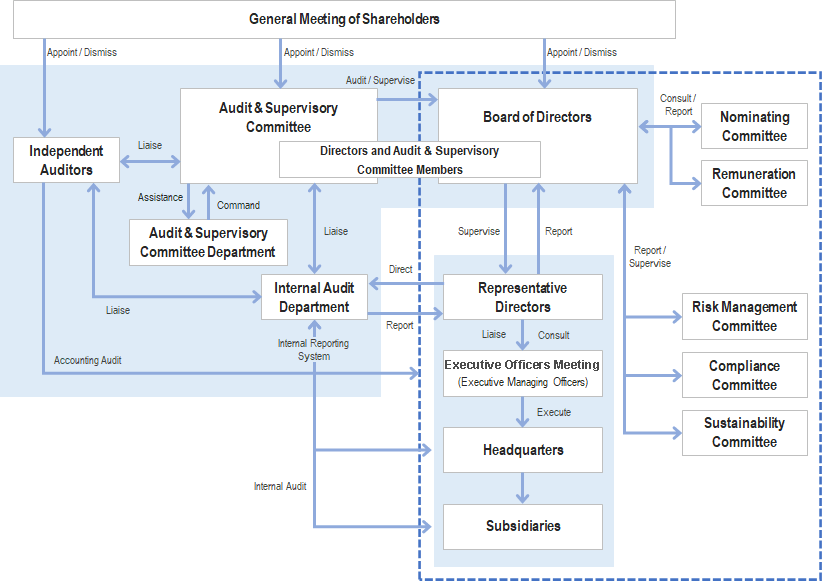
The Board of Directors oversees business execution and makes Important management decisions. The Board consists of five internal directors and six independent outside directors who are familiar with the business environment and well versed in business operations. In accordance with laws and regulations, the Board makes important business execution decisions and reports on the status of key business operations and results. Matters decided by the Board of Directors are moved into business execution of through the Representative Director and each Executive Officer. The Board of Directors meets regularly once a month and as appropriate. Independent outside directors recognize that they are responsible for oversight of and advice to management at the Board of Directors meetings, and contribute to ensuring and improving management transparency.
In addition, our company has established its own "Criteria for the Selection of Director Candidates" as a policy for nominating director candidates.
Furthermore, our company conducts analyses and evaluations of the effectiveness of the Board of Directors with the aim of enhancing its effectiveness and improving corporate value.
Nominating Committee and Remuneration Committee
Our company has established a Nomination Committee and a Remuneration Committee as advisory bodies to the Board of Directors. The Nomination Committee deliberates on matters related to the appointment of directors, executive officers, and board members, while the Remuneration Committee discusses matters concerning the remuneration of directors, executive officers, and board members. Each committee reports its deliberation results to the Board of Directors.
Each committee is composed of a majority of outside directors, and the chairperson is also an outside director, ensuring transparency and objectivity in the deliberation process concerning executive personnel and remuneration systems.
Members of the Board of Directors, the Nomination Committee, and the Remuneration Committee
Please refer to the integrated report and others.
Succession Planning
The Nominating Committee deliberates regularly on the development of successor candidates for executives, referring to our Management Principle, management strategy, and other foundational considerations. Potential successors to top leadership positions are assessed on both performance and learning trajectories. The Nominating Committee reports on the development of candidates to the Board of Directors as appropriate, enabling the Board of Directors to supervise the progress.
Executive Officer Meeting and Executive Officer System
Our company has established an Executive Officer Meeting, mainly composed of executive officers, to complement the functions of the Board of Directors. This meeting conducts preliminary discussions on important matters to be submitted to the Board of Directors, makes decisions on business execution outside the scope of authority of the Board of Directors as stipulated by law, and reports on the status of business execution.
As a result, in reporting and deliberating proposals at the Board of Directors, more emphasis can be placed on decision-making and monitoring and supervising business execution, thereby enhancing these functions.
Management Monitoring System
Audit & Supervisory Committee Members and Audit & Supervisory Committee
The Company has appointed four audit and supervisory committee members, including three independent outside auditors with high independence.
In addition, the Company has established an Audit & Supervisory Committee office to assist the duties of the Audit & Supervisory Committee and has assigned one employee.
This employee operates under the direction and orders of the Audit & Supervisory committee and is not subject to the orders and commands of directors who are not committee members or other executive officers.
Audit & Supervisory Committee members carry out audits on the execution of duties by directors and other bodies in accordance with legal stipulations and the auditing standards, policies, plans, and apportioned duties determined by the Audit & Supervisory Committee.
Specifically, Audit & Supervisory Committee members attend meetings of the Board of Directors and the Executive Committee, as well as other important meetings, and oversee major business execution decisions and documentation related to their execution, if necessary, requesting directors and employees to provide such documents or submit reports, in order to audit and supervise the execution of duties by directors. The Audit & Supervisory Committee convenes every second month and holds regular monthly meetings for the exchange of opinions between Audit & Supervisory Committee members along with essential deliberations regarding the execution of duties by directors.
Beyond emphasizing high-level independence of outside Audit & Supervisory Committee members, Mabuchi's policy is for outside Audit & Supervisory Committee members to represent more than half of the Audit & Supervisory Committee. Mabuchi also elects Audit & Supervisory Committee members with either specialist viewpoints or considerable knowledge of legal, financial and accounting matters.
As necessary, Audit & Supervisory Committee members receive relevant material information from the director responsible for internal control, the Internal Control Department, the independent auditor, and the Internal Audit Department upon inquiry. Audit & Supervisory Committee members and directors receive reports and advice from the Audit & Supervisory Committee.
Members of the Audit and Supervisory Committee, etc.
Please refer to the integrated report and others.
Internal Audit Department
Mabuchi has established the Internal Audit Department under the direct control of the president. This body liaises with the Audit & Supervisory Committee (members), the director responsible for internal control, and the Internal Control Department on a timely basis and conducts ongoing supervision of the upgrading, running, and effectiveness of the internal control framework for Mabuchi and its Group companies. The Internal Audit Department reports its findings to the president, directors, and Audit & Supervisory Committee members.
Independent Auditor
With respect to accounting audits, the Company has formed an auditing agreement with Ernst & Young ShinNihon LLC to carry out audits under Japan's Companies Act and Financial Instruments and Exchange Law. Ernst & Young ShinNihon conducts audits and reviews of the Company's annual and quarterly financial results based on an independent, third-party standpoint. From Ernst & Young ShinNihon, the Company receives reports as appropriate on issues identified during the audit implementation process. The Company also receives reports from Ernst & Young ShinNihon on both the results of audits and the effectiveness of internal control regarding financial reporting at the Audit Report Meeting (attended by the director responsible for internal control and Audit & Supervisory Committee members) following the end of each financial period, and responds in a timely manner if there are any discrepancies.
Internal Control System
In accordance with the Basic Policy on Internal Controls approved at a meeting of the Board of Directors, Mabuchi established and is now operating an internal control system. In this way, inadequacies in internal controls and other issues discovered in risk management activities, compliance activities, Audit & Supervisory Committee members' audits, and internal audit activities are reported to the directors and Audit & Supervisory Committee members on a periodic or non-periodic basis, and appropriate corrective measures are taken in a timely manner. These efforts provide the Company with a framework for continuously enhancing the functioning and effectiveness of the internal control system. By establishing and ensuring the appropriate application of internal regulations governing the approval system, job authority and division of responsibilities, and other matters, the Company seeks to further ensure the appropriate conduct of business. These various internal mechanisms serve to support the monitoring and supervision of the conduct of business by directors.
Risk Management System
In accordance with the Basic Policy on Internal Control, Mabuchi has designated a director with overall control over risk management and the departments responsible for risk management; has prepared and established internal rules and procedures necessary for appropriate management of risk; and has taken necessary measures, including informing and educating employees about risk management.
In addition, Mabuchi has established the Risk Management Committee, whose members are the persons responsible for risk management at each company department and subsidiary; has made possible cross-organizational activities concerning risk awareness and assessment in routine business activities, risk response, and information provision; and has put in place a Group Emergency Response System to prepare for contingencies, with the objective of protecting all Group business activities in the event of an emergency. Furthermore, the Internal Audit Department periodically audits the status of risk management and reports the audit results to the Board of Directors and Audit & Supervisory Committee. The Board of Directors reviews the report and takes any necessary measures, allowing Mabuchi to pursue continuous improvement of the risk management system.